
Pull-Down vs Pull-Out Kitchen Faucets: Key Differences Explained
Ask ten people what the difference is between a pull-down and a pull-out kitchen faucet, and most will just shrug — the names sound almost interchangeable. They're not, and the difference actually shows up every time you're rinsing a pot or filling a tall vessel at the sink. Getting this choice wrong doesn't ruin a kitchen, but it does turn into a small daily irritation that people don't expect until they're already living with it.
I've fielded this question more than once from people mid-renovation, usually after they've already fallen for a faucet's finish or shape without checking which spray mechanism it actually uses. Both styles do the same basic job — extend the spray head on a flexible hose for more reach — but they go about it in noticeably different ways.
The Real Difference: Direction of Pull
The names actually describe the mechanism accurately once you know what to look for.
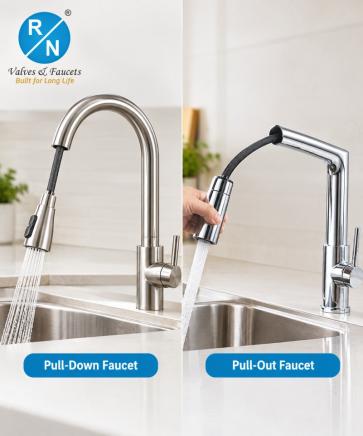
A pull-down faucet has a tall, arched spout, and the spray head pulls straight down toward the sink basin. The hose retracts vertically, which is why these faucets tend to have a taller gooseneck-style profile even before you touch them.
A pull-out faucet sits lower and closer to horizontal, with a shorter spout, and the spray head pulls out toward you, extending horizontally across the sink rather than down into it.
That single mechanical difference changes almost everything else about how each one behaves day to day.
Why the Pull Direction Actually Matters
With a pull-down design, the extended hose gives you height and reach for filling large pots directly under a tall spout, and the water tends to fall more naturally back into the basin when you're done using the sprayer, since gravity is working with the mechanism rather than against it.
A pull-out design gives you more horizontal reach across a wide sink or double basin, which helps if you're rinsing something in one side and need the spray to reach the other. But because the motion is horizontal, there's slightly more chance of water trailing outside the basin if you're not paying attention while spraying.
Comparing Everyday Use
Clearance and vessel washing. Pull-down faucets typically offer better clearance under the spout at rest, which matters if you regularly wash tall vessels, stockpots, or vases. Pull-out faucets sit lower, which can restrict clearance for larger items even though the hose itself extends just as far, sometimes farther.
Counter and cabinet space. A pull-down faucet's arched design takes up more visual height above the sink, which can look cramped under a low cabinet or shallow window. A pull-out faucet's lower profile tends to fit better in kitchens with limited overhead clearance.
Retraction and hose behavior. Pull-down hoses generally retract more smoothly because gravity assists the motion. Pull-out hoses rely more heavily on the internal counterweight or spring mechanism to retract fully, and lower-quality models sometimes leave the head sitting slightly extended instead of snapping cleanly back into the dock.
A Few Things Worth Checking Regardless of Style
Whichever direction you lean toward, a handful of build details separate a faucet that lasts from one that doesn't:
- Hose material — braided stainless steel hoses resist kinking and cracking far longer than basic rubber hoses, especially with daily use.
- Docking magnet strength — a weak magnet lets the spray head wobble loose over time, which becomes noticeable within the first year of regular use.
- Cartridge type — ceramic disc cartridges last significantly longer than older washer-based designs and handle hard water better in both faucet types.
- Spray mode switching — check whether the mode toggle (stream vs. spray) is a simple button press or something fiddlier, since this gets used multiple times a day.
How to Decide Between the Two
- Measure the height between your sink basin and any cabinet or window above it — limited clearance often rules out a pull-down design outright.
- Think honestly about what you wash most often; frequent tall-pot use favors pull-down, while wide or double-basin sinks often work better with pull-out reach.
- Check the hose material and docking mechanism specifications before comparing finish or price, since these determine long-term reliability more than either factor.
- If possible, test the retraction action in a showroom or ask a seller for a demonstration video, since photos alone won't show you how smoothly the head docks back into place.
The Final Word
Neither pull-down nor pull-out kitchen faucets are objectively better — they're built for slightly different sink habits and kitchen layouts. Pull-down models suit taller vessels and give a cleaner gravity-assisted retraction, while pull-out models offer better horizontal reach for wide sinks with less overhead clearance. Once you know your own sink's clearance and how you actually use it day to day, choosing between kitchen faucets built around these two mechanisms becomes a much easier call than it looks on a showroom floor.
Recent Post
-
Pull-Down vs Pull-Out Kitchen Faucets: K...
22 Sep 2026 -

Best CP Faucet Features for Commercial B...
22 Sep 2026 -
DIY Plumbing Fixes: From Clogged Drains ...
04 Sep 2026


